
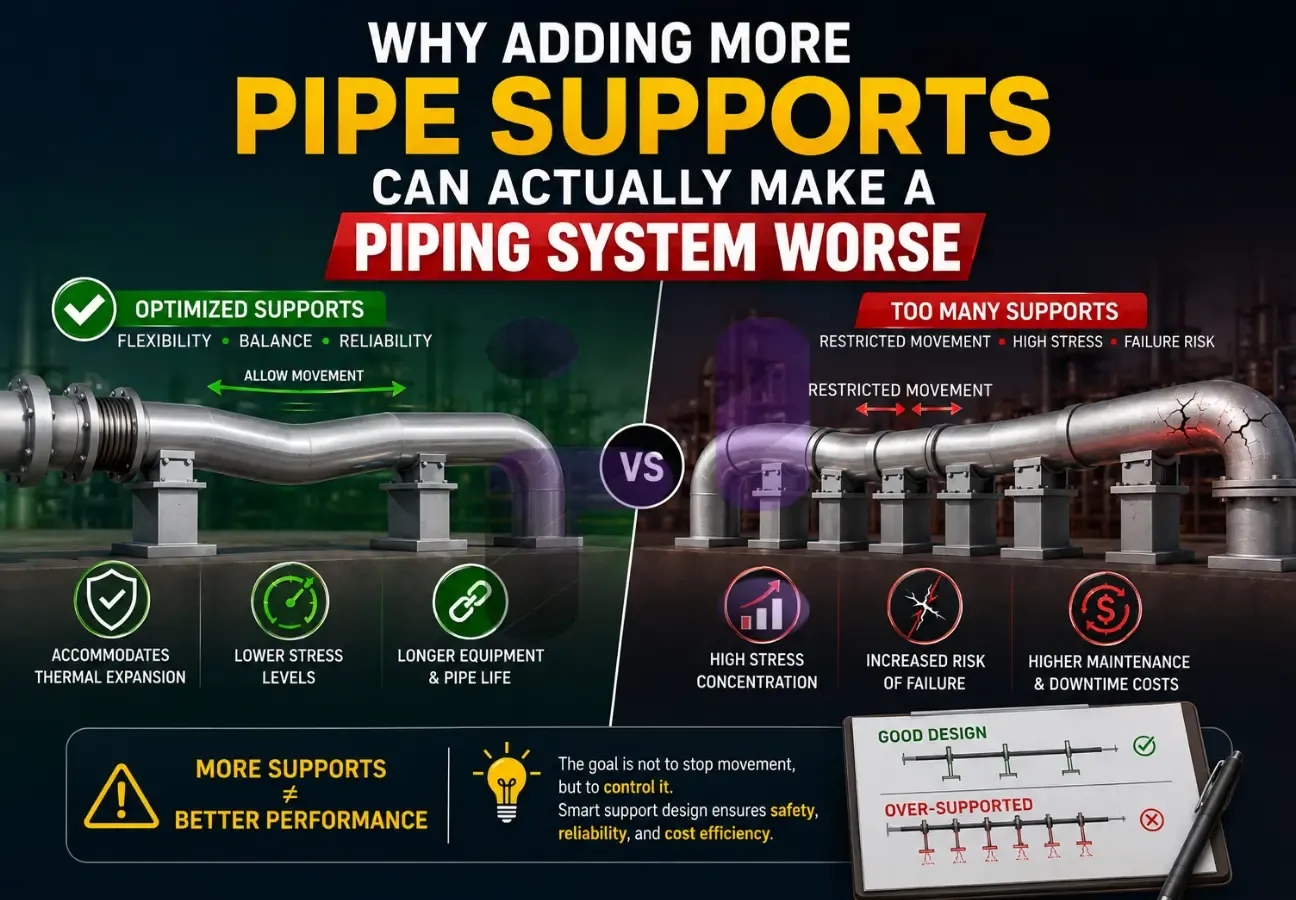
Why Adding More Pipe Supports Can Actually Make a Piping System Worse
Is your pipe support arrangement helping or hurting your piping system?
More support does not always mean more stability. In industrial piping systems, an overly conservative approach to pipe support design can actually introduce new stresses, restrict thermal movement, and increase loads on equipment and structures.
Pipe supports are essential for carrying pipe weight, controlling movement, maintaining clearances, and protecting connected equipment. But every additional support also changes how a piping system behaves under operating conditions.
In this article, you'll discover:
Key Takeaway: The objective of pipe support design is not to use the maximum number of supports—it is to use the right supports in the right locations while allowing the piping system to respond safely to operating loads.
Why Pipe Support Design Is More Than Just Supporting Weight
At first glance, pipe support design seems straightforward: the pipe is heavy, so supports are added at regular intervals to keep it off the ground. In reality, supports form part of the structural and mechanical behavior of the entire piping system. Their location, type, stiffness, and restraint direction can determine how forces and movements are distributed.
What Does a Pipe Support Actually Do?
Depending on the application, a support may be designed to:
A resting support, guide, line stop, anchor, spring support, and dynamic restraint each influence the piping system differently. Treating every support as a simple "pipe holder" can lead to an inaccurate design.
The Problem With Adding Supports Everywhere
Imagine a long hot piping line that needs to expand when it reaches operating temperature. If the line has enough flexibility, it can expand through bends and changes in direction. But if numerous supports and restraints prevent that movement, thermal expansion has fewer places to go.
The result can be increased loads at:
The pipe may remain physically supported while becoming mechanically over-restrained.
Understanding Pipe Over-Restraint
Pipe over-restraint occurs when the piping system is excessively restricted from moving in directions where movement is required or expected. This does not necessarily mean the pipe will immediately fail. Instead, the additional restraints can create undesirable forces and stresses that may only become apparent during operating conditions.
Typical warning signs include:
Load Indicators
Behavioral Signs
A support can therefore solve one problem while creating another.
How Pipe Support Spacing Affects Piping Performance
Pipe support spacing is an important part of piping design, but there is no universal rule that says closer supports always produce a better system. Support spacing must consider the pipe's physical characteristics, operating conditions, loads, configuration, and applicable design requirements.
What Determines Appropriate Support Spacing?
Several factors influence support spacing, including:
Why Uniform Spacing Is Not Always the Best Solution
Standard support-spacing tables are useful starting points, but they should not replace engineering evaluation. A piping layout may contain:
A better approach is to establish preliminary spacing and then evaluate the actual piping configuration.
The Difference Between Support and Restraint
This distinction is particularly important. A simple resting support primarily carries vertical load. A guide may restrict lateral movement while allowing axial movement. An anchor can restrict movement in multiple directions. If a designer adds a restraint when only vertical support was required, the system's flexibility can change significantly.
Common Question
"Where does this pipe need another support?"
Better Question
"With this support, what movement or load are we attempting to control?"
How Piping Stress Analysis Helps Prevent Over-Supporting
A good support arrangement should be evaluated as part of the overall piping system—not independently from it. This is where piping stress analysis becomes valuable.
Evaluating Thermal Expansion
Temperature changes can cause significant movement in industrial piping. As the pipe expands when heated, if supports allow the expected movement, the system can accommodate thermal expansion through its flexibility. If supports excessively restrict that movement, thermal loads can increase.
Stress analysis can help engineers evaluate:
Finding the Right Balance
Effective pipe support design balances two competing requirements: Support the pipe enough to control weight and stability—but not so much that the system becomes excessively restrained. The correct solution may involve changing support locations, introducing flexibility, or using a spring support rather than simply adding another rigid restraint.
Reviewing Support Reactions
Stress analysis provides more information than pipe stress ratios. Engineers should also examine support reactions to identify unusual behavior. A useful review can include:
Key Takeaway: More supports do not automatically mean a better piping system. The best pipe support design provides adequate weight support and stability while allowing controlled thermal movement and avoiding unnecessary restraint.
Common Pipe Support Design Mistakes to Avoid
Mistake 1: Treating Every Support as Rigid
A rigid support may look simple on a drawing, but it can significantly affect thermal movement. Before specifying a rigid restraint, engineers should understand which degrees of freedom actually need to be restricted.
Mistake 2: Ignoring Heavy Components
Valves, strainers, specialty components, and other concentrated loads can create local bending effects. Support locations should be evaluated around heavy components rather than relying exclusively on standard spacing.
Mistake 3: Supporting Too Close to an Elbow
Support locations near elbows can affect the flexibility of the piping system. Depending on the configuration, moving a support can either improve or reduce the system's ability to absorb thermal expansion.
Mistake 4: Adding Supports to Fix a Stress Problem
Adding a support may reduce movement but increase restraint forces elsewhere. Engineers should investigate the cause and evaluate alternatives such as:
Mistake 5: Designing Without Considering Construction
A theoretically excellent support arrangement may be difficult or expensive to install. Support design should consider:
A Better Approach to Pipe Support Design
A systematic process can help industrial companies avoid both under-supporting and over-supporting their piping systems.
Step 1: Understand the Piping System
Review the piping layout, operating conditions, equipment connections, pipe specifications, insulation, fluid characteristics, and applicable design requirements.
Step 2: Establish Preliminary Support Locations
Use engineering standards and practical experience to establish initial support locations. These should be treated as a starting point—not automatically as the final arrangement.
Step 3: Identify Critical Areas
Pay particular attention to:
Step 4: Perform Piping Stress Analysis
Evaluate the system under applicable load cases and operating conditions. Review both stress results and the overall behavior of the system.
Step 5: Optimize the Support Arrangement
If the results indicate excessive movement, stress, or reactions, modify the support strategy. The solution may involve adding a support—but it could just as easily involve relocating or removing one.
Step 6: Verify the Final Design
Before issuing the final support arrangement, confirm that:
"The pipe whose supports work with its natural movement is the best-supported pipe, not the pipe with the most supports."
FAQ: Pipe Support Design
Summary
Effective pipe support design is about balance, not quantity. While supports are essential for carrying weight, maintaining stability, and controlling movement, adding too many rigid supports can restrict thermal expansion and create pipe over-restraint. The right solution considers pipe support spacing, support type, thermal movement, equipment connections, structural requirements, and the overall behavior of the piping system.
Conclusion
Effective pipe support design is about balance, not quantity. For industrial projects, combining practical support engineering with piping stress analysis can help identify problems before fabrication and installation. It can also reduce unnecessary steelwork, field modifications, equipment loading, and long-term maintenance concerns.
The right support strategy delivers:
Planning a New Piping System or Reviewing an Existing Support Arrangement?
Contact Haddy Designs to discuss your pipe support design and piping stress analysis requirements.
Get In Touch