
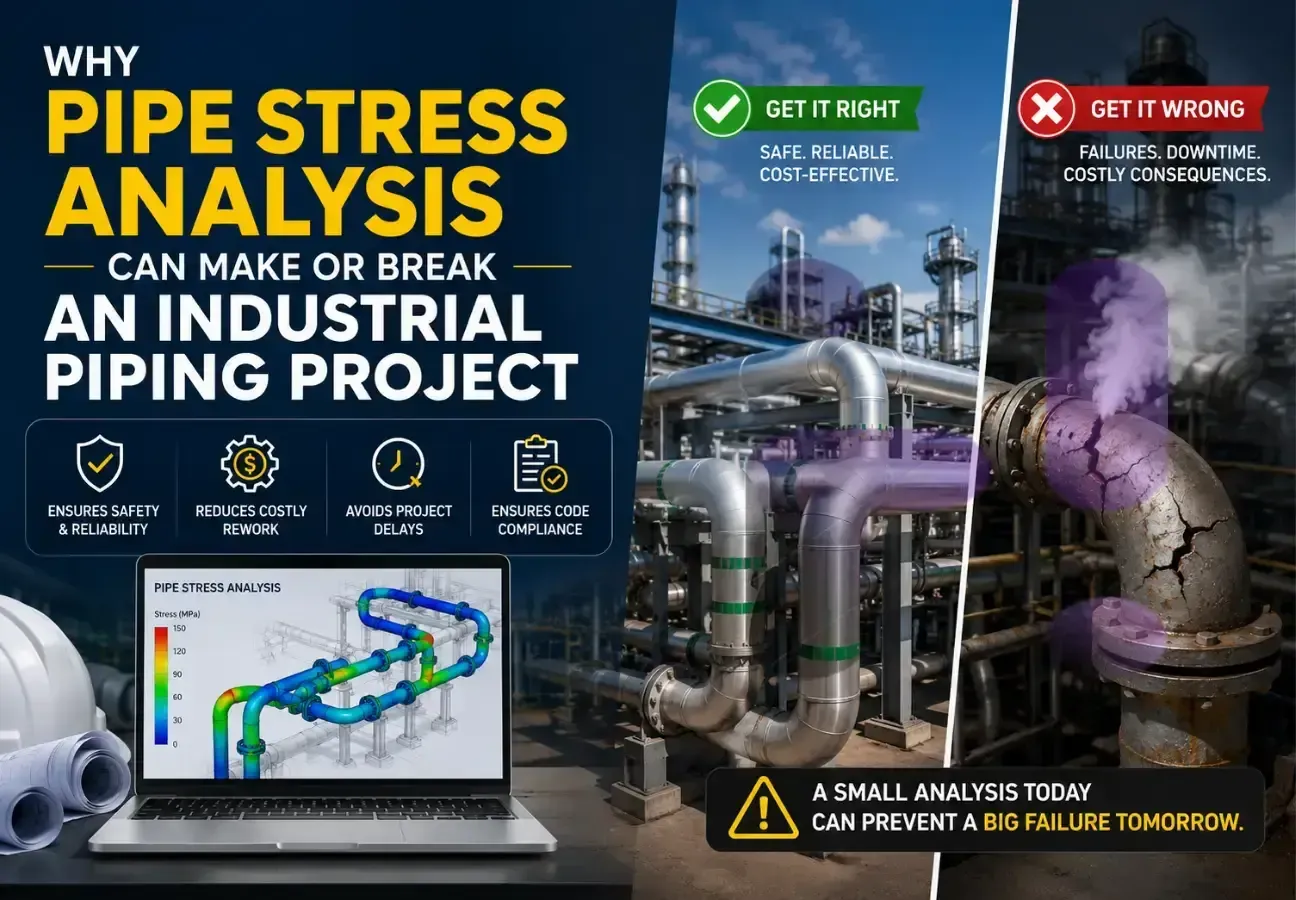
Why Pipe Stress Analysis Can Make or Break an Industrial Piping Project
Is your industrial piping system properly analyzed for stress?
In industrial facilities, piping systems are expected to operate reliably under pressure, temperature changes, vibration, and mechanical loads—often for decades. A well-designed piping system must do more than connect equipment and transport fluids. It needs to withstand operating conditions while protecting connected equipment, supports, joints, valves, and the surrounding structure.
Pipe stress analysis is more than a technical engineering exercise; it can be the difference between a safe, efficient project and one plagued by failures, costly modifications, and unexpected downtime.
In this article, you'll discover:
Key Takeaway: Pipe stress analysis helps engineers identify excessive loads and movement before construction, allowing design problems to be solved on paper instead of at the job site.
Why Is Pipe Stress Analysis Important?
Pipe stress analysis is an engineering process used to determine how a piping system responds to mechanical and thermal loads during operation. Engineers evaluate stresses, displacements, forces, moments, and loads transferred to connected equipment and supports.
The goal is straightforward: make sure the piping system can safely handle its expected operating conditions throughout its service life.
What Loads Are Considered in Pipe Stress Analysis?
A piping system can experience many different loads, including:
Each load can affect the piping system differently. For example, a temperature increase can cause a long pipe run to expand significantly, creating additional forces at anchors, guides, supports, and connected equipment. Without proper analysis, these forces may result in excessive stress or equipment loading.
Why Pipe Stress Analysis Is Important for Industrial Facilities
Industrial piping systems often connect critical equipment such as pumps, compressors, pressure vessels, heat exchangers, tanks, and turbines. A piping layout that appears practical in a 3D model may behave very differently once the system reaches operating temperature.
Effective analysis helps engineers:
How Pipe Stress Analysis Supports Industrial Piping Design
Pipe stress analysis should not be treated as an isolated activity performed after the piping layout is complete. It works best as part of an integrated industrial piping design process.
Designing for Thermal Expansion
Thermal expansion is one of the most important considerations in industrial piping. When a pipe heats up, it expands. When it cools down, it contracts. If the piping system does not have enough flexibility to accommodate this movement, significant forces can develop.
Engineers can address thermal movement through design features such as:
Protecting Connected Equipment
Piping does not operate independently. It is connected to equipment with specific allowable loads. Excessive forces or moments at an equipment nozzle can create operational and mechanical problems, even when the pipe itself appears to satisfy stress requirements.
This is particularly important around:
Optimizing Supports and Restraints
Pipe supports do much more than carry the weight of a pipe. Their location and configuration influence how a piping system moves and how loads are distributed. Poorly positioned supports can restrict thermal expansion or create excessive reactions.
A stress analysis can help determine where engineers may need:
The Cost of Skipping or Delaying Piping Stress Analysis
One of the biggest misconceptions in industrial projects is that pipe stress analysis is primarily a compliance requirement. In reality, it is also a risk-management and cost-control tool.
Problems That Can Appear Without Proper Analysis
When piping flexibility and stress are not adequately evaluated, companies may encounter:
Structural Failures
Operational Problems
Project Impact
Why Early Analysis Saves Money
Early pipe stress analysis gives project teams an opportunity to identify issues while changes are still relatively inexpensive. A practical workflow looks like this:
"The earlier a piping problem is identified, the less expensive it is to correct."
What Makes an Effective Pipe Stress Analysis?
A useful analysis depends on more than simply running engineering software. The quality of the results depends heavily on the accuracy of the inputs, assumptions, modeling approach, and engineering judgment.
Accurate Project Inputs
Engineers typically need information such as:
Appropriate Engineering Judgment
Software can calculate stresses, forces, moments, and displacements, but engineers still need to interpret those results. Good engineering balances:
Code Compliance
Industrial piping systems are commonly designed and evaluated against applicable piping codes and project specifications. Depending on the application and jurisdiction, this may include standards such as:
How Haddy Designs Can Help
For industrial companies, the value of pipe stress analysis goes beyond producing a calculation report. The real value comes from using analysis to make better design decisions. Haddy Designs can support industrial piping projects by integrating engineering analysis with practical piping design considerations.
FAQs: Pipe Stress Analysis
Summary
Industrial piping systems must perform reliably under real-world operating conditions—not just look correct on a drawing. That is why pipe stress analysis plays such an important role in safe, reliable, and cost-effective industrial piping design. By evaluating thermal expansion, sustained and occasional loads, equipment interactions, support reactions, and system flexibility early in the project, engineering teams can identify potential problems before they become expensive field issues.
Conclusion
Industrial piping systems must perform reliably under real-world operating conditions—not just look correct on a drawing. For industrial companies, the investment in piping stress analysis can deliver more than code compliance.
It can support:
Ready to Strengthen Your Next Industrial Piping Project?
Contact Haddy Designs to discuss your piping design and pipe stress analysis requirements and find the right engineering approach for your project.
Get In Touch