
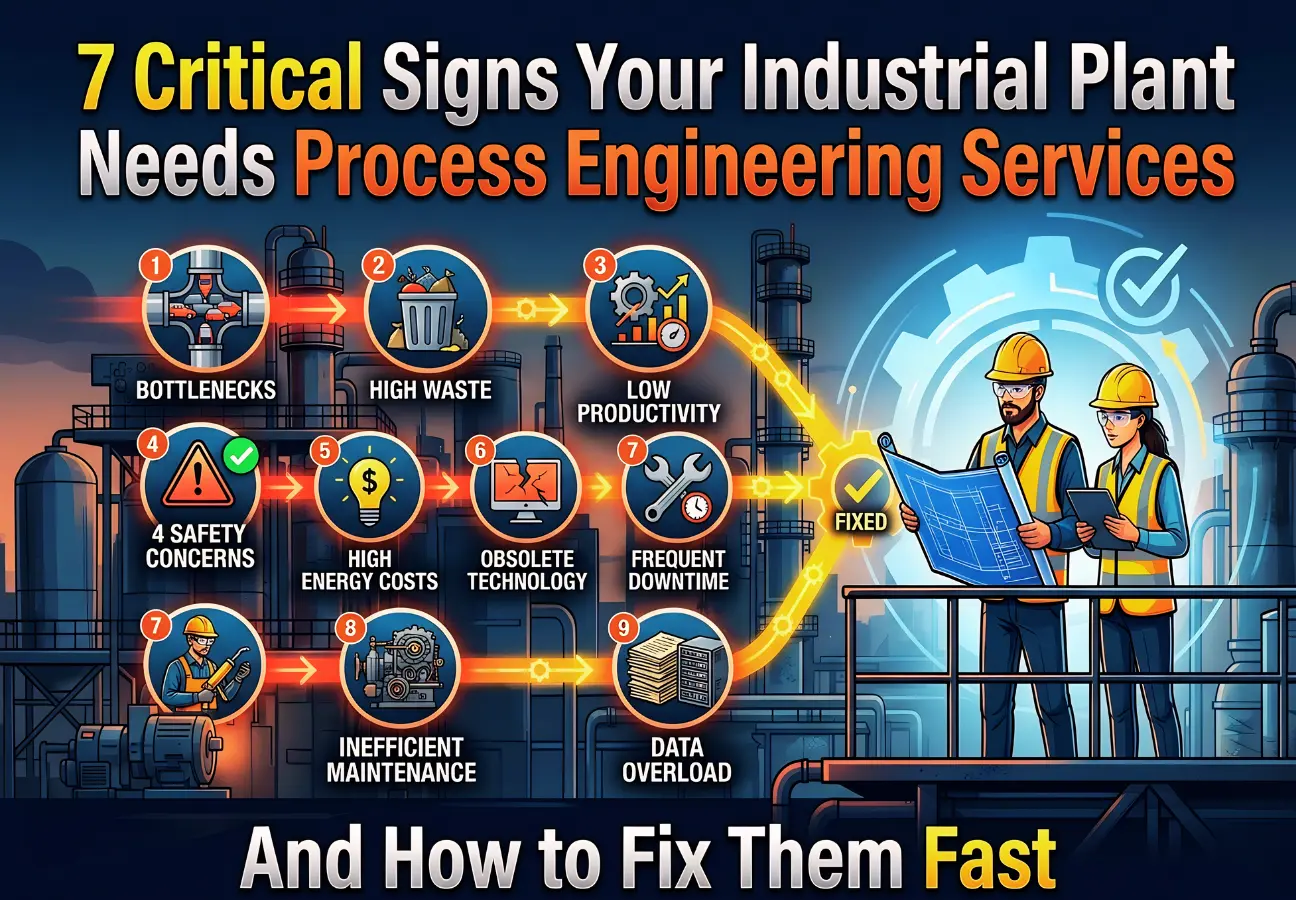
7 Critical Signs Your Industrial Plant Needs Process Engineering Services And How to Fix Them Fast
Is your industrial plant losing efficiency, increasing costs, or struggling with inconsistent output?
Many manufacturing facilities operate with hidden inefficiencies that quietly reduce profitability. Without proper optimization, even small process issues can lead to major operational losses.
Process engineering services help identify these gaps and transform plant performance using data-driven strategies, automation, and workflow optimization.
In this guide, you'll learn:
What Are Process Engineering Services?
Process engineering services involve analyzing, designing, and optimizing industrial processes to improve efficiency, reduce operational costs, enhance safety, and increase production output. These services use tools like automation systems, process simulation, and workflow optimization to improve plant performance.
What Are the Signs Your Plant Needs Process Engineering Services?
Your plant likely needs process engineering services if you experience:
Why Process Engineering Services Are Essential for Industrial Growth
Modern industrial plants require more than functional systems — they need optimized, scalable, and efficient processes.
Core Components
Process design, simulation, equipment sizing, automation (PLC, SCADA), and industrial workflow optimization.
Safety & Compliance
Hazard identification, regulatory compliance assurance, improved operational safety and reduced system failures.
Process engineering services improve efficiency by optimizing workflows, reducing waste, implementing automation systems, and improving energy usage. This results in higher productivity, lower costs, and more reliable operations.
7 Critical Signs Your Industrial Plant Needs Process Engineering Services
01. Frequent Equipment Failures
Repeated breakdowns often indicate deeper process inefficiencies. Common causes include poor system design, equipment overload, and lack of predictive maintenance.
02. Rising Operational Costs Without Output Growth
If your costs are increasing without higher production, inefficiencies are likely present.
03. Inconsistent Product Quality
Variability in production output signals weak process control. Reasons include lack of automation, improper calibration, and unstable workflows.
04. Production Bottlenecks
Delays in one stage disrupt the entire system. Causes include imbalanced production lines, inefficient layout design, and equipment limitations.
05. Safety Issues and Compliance Risks
Frequent incidents or near-misses indicate process gaps. Warning signs include outdated systems, poor hazard analysis, and non-compliance.
06. Difficulty Scaling Operations
If your plant struggles to meet demand, your processes aren't scalable. Limitations include rigid workflows, lack of automation, and inefficient planning.
07. Over-Reliance on Manual Processes
Manual operations slow performance and increase errors. Indicators include spreadsheet-based tracking, lack of integration, and human-dependent controls.
Key Takeaway: If your plant is experiencing inefficiencies, rising costs, or operational risks, investing in process engineering services can deliver immediate and long-term performance improvements.
How Process Engineering Services Transform Industrial Performance
Process Optimization
Eliminates inefficiencies, improves production flow, and increases overall output capacity.
Automation & Control
PLC and SCADA systems with real-time monitoring for higher precision and reduced human error.
Quick Summary
Process engineering services help industrial plants improve efficiency, reduce costs, and eliminate bottlenecks. By implementing automation, optimizing workflows, and using data-driven insights, companies can increase productivity, improve quality, and scale operations effectively.
Key Insights
Example Use Case for Process Engineering
A manufacturing plant experiencing frequent downtime and high energy costs implemented process engineering solutions, including workflow redesign and automation systems.
Results Achieved:
Process Engineering vs Traditional Operations
| Aspect | Traditional Operations | Process Engineering Approach |
|---|---|---|
| Efficiency | Reactive | Proactive & optimized |
| Maintenance | Breakdown-based | Predictive |
| Cost Control | Unstructured | Data-driven |
| Scalability | Limited | High |
Why Are Process Engineering Services Important for Industrial Plants?
Process engineering services are important because they help industrial plants reduce costs, improve efficiency, enhance safety, and scale operations effectively. By optimizing workflows and integrating automation, businesses achieve consistent performance and long-term growth.
FAQs: Process Engineering Services
Conclusion
Hidden inefficiencies can quietly drain your plant's performance and profitability.
By recognizing these 7 critical signs, you can take proactive steps to improve operations, reduce costs, and stay competitive in today's industrial landscape.
Process engineering services are not just an upgrade — they're a strategic investment in long-term growth.