
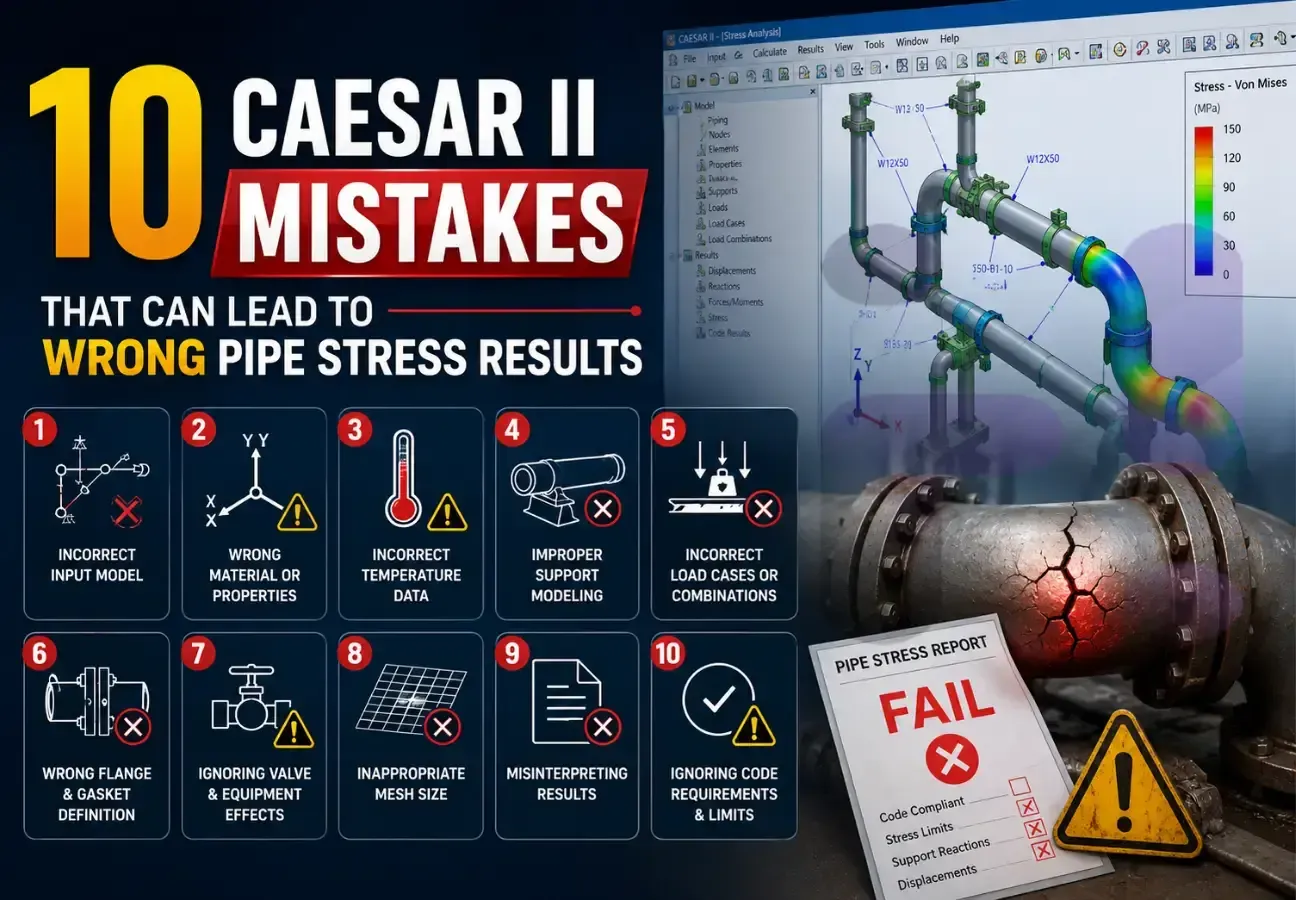
10 CAESAR II Mistakes That Can Lead to Wrong Pipe Stress Results
Is your CAESAR II model producing reliable results?
A pipe stress model can look technically correct and still produce misleading results. CAESAR II only evaluates the information provided to it. Incorrect inputs, unrealistic boundary conditions, missing loads, or poorly defined geometry can lead to results that appear credible but do not accurately represent the real piping system.
Understanding CAESAR II mistakes is essential for engineers working on industrial piping systems where safety, reliability, and project cost are all critical.
In this article, you'll discover:
Key Takeaway: CAESAR II is only as reliable as the information provided to it. Correct geometry, material data, operating conditions, supports, and boundary conditions are essential before interpreting calculated stresses.
1. Incorrect Pipe Geometry and Node Modeling
The foundation of any pipe stress model is its geometry. If the model does not accurately represent the physical piping arrangement, even a technically flawless analysis can produce the wrong engineering conclusion.
Mistake 1: Incorrect Node Locations
Node numbers represent points along the piping system where geometry, supports, loads, restraints, or other properties can change. Common modeling problems include:
Mistake 2: Oversimplifying the Piping Layout
Engineers sometimes simplify a piping system to make modeling faster. Simplification can be appropriate, but excessive simplification may remove important flexibility or restraint characteristics.
For example, eliminating a small offset that exists in the actual piping arrangement could make a line appear more flexible or more rigid than it really is. The model should be simplified only when the simplification does not materially affect the behavior being evaluated.
2. Incorrect Material, Temperature, and Operating Inputs
Material properties and operating conditions directly influence pipe stress calculations. Incorrect inputs are therefore among the most important CAESAR II modeling errors to catch.
Mistake 3: Using Wrong Material Properties
Different materials behave differently under temperature and loading. Incorrect material selection can affect properties such as:
Mistake 4: Entering Incorrect Operating Temperatures
Thermal expansion is a major driver in many piping systems. If the operating or design temperature is incorrect, the calculated thermal expansion can differ significantly. Important temperatures to verify include:
3. Incorrect Supports and Boundary Conditions
Supports and restraints determine how a piping system is allowed to move. Incorrect support modeling can therefore create some of the most significant errors in a stress analysis.
Mistake 5: Modeling Supports Incorrectly
A support that is modeled as fully rigid may behave differently in reality because of clearances, friction, structural flexibility, or installation conditions. Common support-related errors include:
Mistake 6: Ignoring Friction or Modeling It Unrealistically
Friction can have a significant influence on piping behavior, particularly in systems with long horizontal runs and multiple supports.
Key Takeaway: A CAESAR II model is only as reliable as its representation of the physical piping system. Correct geometry, material data, operating conditions, supports, and boundary conditions are essential before interpreting calculated stresses.
4. Missing or Incorrect Loads in CAESAR II Pipe Stress Analysis
A piping system rarely experiences a single load case. Industrial piping may be exposed to pressure, weight, thermal expansion, wind, seismic events, relief loads, vibration, and other occasional loads.
Mistake 7: Missing Important Load Cases
One of the most common CAESAR II mistakes is analyzing only the obvious operating condition while overlooking other required load cases. The analysis may need to consider:
Mistake 8: Incorrect Weight Modeling
Weight is often more complicated than simply entering pipe weight. The model may need to account for:
5. Misinterpreting CAESAR II Results
Running the model successfully does not automatically mean the engineering conclusion is correct.
Mistake 9: Looking Only at Stress Ratios
Stress ratios are important, but they are only one part of the analysis. An engineer should also review:
Mistake 10: Accepting Results Without Engineering Review
CAESAR II is an engineering analysis tool, not a replacement for engineering judgment. A model should be reviewed for physical plausibility. Ask questions such as:
How to Prevent Common CAESAR II Errors
Many modeling problems can be prevented through a structured review process.
Use a Pre-Analysis Checklist
Before finalizing a CAESAR II model, verify:
Compare the Model Against Engineering Documents
The stress model should be checked against the latest available:
Why Accurate CAESAR II Modeling Matters to Industrial Projects
For industrial companies, inaccurate pipe stress results can have consequences far beyond an engineering report. A flawed analysis may contribute to:
Project Impact
Operational Impact
When Should a CAESAR II Model Be Reviewed?
A review should ideally happen throughout the engineering lifecycle rather than only at the final submission stage. Useful review points include:
Early reviews make it easier to correct CAESAR II modeling errors before they affect downstream engineering and construction.
FAQ: Common CAESAR II Errors
Summary
Accurate pipe stress analysis depends on much more than pressing "run" in engineering software. Understanding CAESAR II mistakes is essential for ensuring that the model reflects the actual piping system and that the resulting engineering decisions are reliable. From incorrect geometry and material properties to missing load cases, unrealistic supports, and poor result interpretation, each modeling error can affect the final stress evaluation.
Conclusion
For industrial projects, a disciplined approach to CAESAR II pipe stress analysis can help reduce engineering risk, prevent costly modifications, protect connected equipment, and improve piping system reliability. At Haddy Designs, our focus is on combining engineering knowledge, careful modeling, and practical project understanding to support reliable industrial piping solutions.
A disciplined CAESAR II approach can help:
Planning a Piping Stress Analysis or Reviewing an Existing CAESAR II Model?
Contact Haddy Designs to discuss your project requirements and get engineering support tailored to your industrial piping system.
Get In Touch